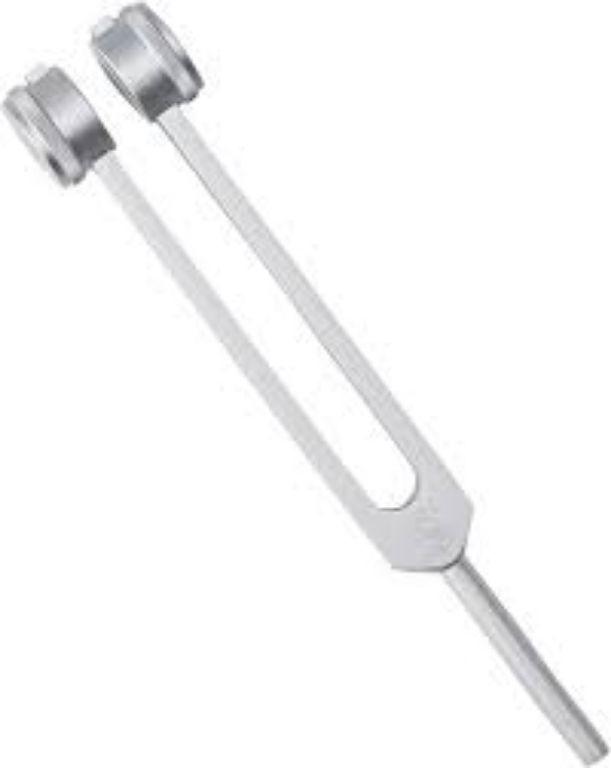
Tuning forks, typically aluminum, consist of a stem (handle) and two prongs that form a U-shaped fork (Figure 4-13). The tuning fork vibrates at a set frequency after being struck on the heel of the hand and is used to assess vibratory sensation and hearing (air conduction and bone conduction).
We are your One Stop Hub Dealer, Supplier, Wholesale, Distributor for Medical Equipment | Hospital Supplies | Lab Consumables | Surgical Instruments | Dental Care | Clinical Devices | PPE Kits | Disinfectants | Consumables & Disposables |Lab Diagnostics & Instruments | Medical Device & Equipment |Medical Implants | Hospital Establishment | Physiotherapy & Rehabilitation-Medical Aids | Mobility Aid | Medical Furniture | Gynaecology & Infant Care | Hospital Holloware | Lab Reagents | Radiology Equipment (Ultrasound, X-ray Machine, CT, MRI, ECG)
WE CAN SUPPLY AND INSTALL ANYWHERE IN NIGERIA
OFFICES IN LAGOS, ABUJA, PORT HARCOURT AND BENIN CITY
Please CALL: 0907-643-3020, 0904-936-7703
WhatsApp: https://wa.me/2349076433020
WhatsApp: https://api.whatsapp.com/send?phone=2349049367703
Email: scantrikmedicalsupplies@gmail.com
Web: www.scantrikmedicalsupplies.ng/products
Instagram: www.instragram.com/scantrikmedicalsupplies
Overview
Features:
- Material: Tuning forks are typically made from aluminum alloy.
- Shape: Tuning forks are U-shaped, with a stem (handle) and two prongs.
- Frequency: Tuning forks come in a range of frequencies, from 64 Hz to 4096 Hz. A common frequency for screening is 128 Hz.
- Vibration: When struck, tuning forks vibrate at a specific frequency. The vibrations produce sound waves that can be used to assess a patient's hearing and neurological functions.
- Use: Tuning forks are used to assess a range of medical conditions, including hearing ability, vibration sense, and bone fractures.
- How to use: To use a tuning fork, hold it by the stem and strike it on the heel of your hand.